
Picking an internet provider feels like a small decision. You compare speeds, check prices, and go with whoever shows up first in the search results. Nine times out of ten, that’s a national telecom giant.
But there’s a real case for looking closer to home. Local broadband internet providers have advantages that the big players simply can’t match, and most people don’t realize this until something goes wrong with their connection at 11 PM.
Here’s what we found when we looked closely.
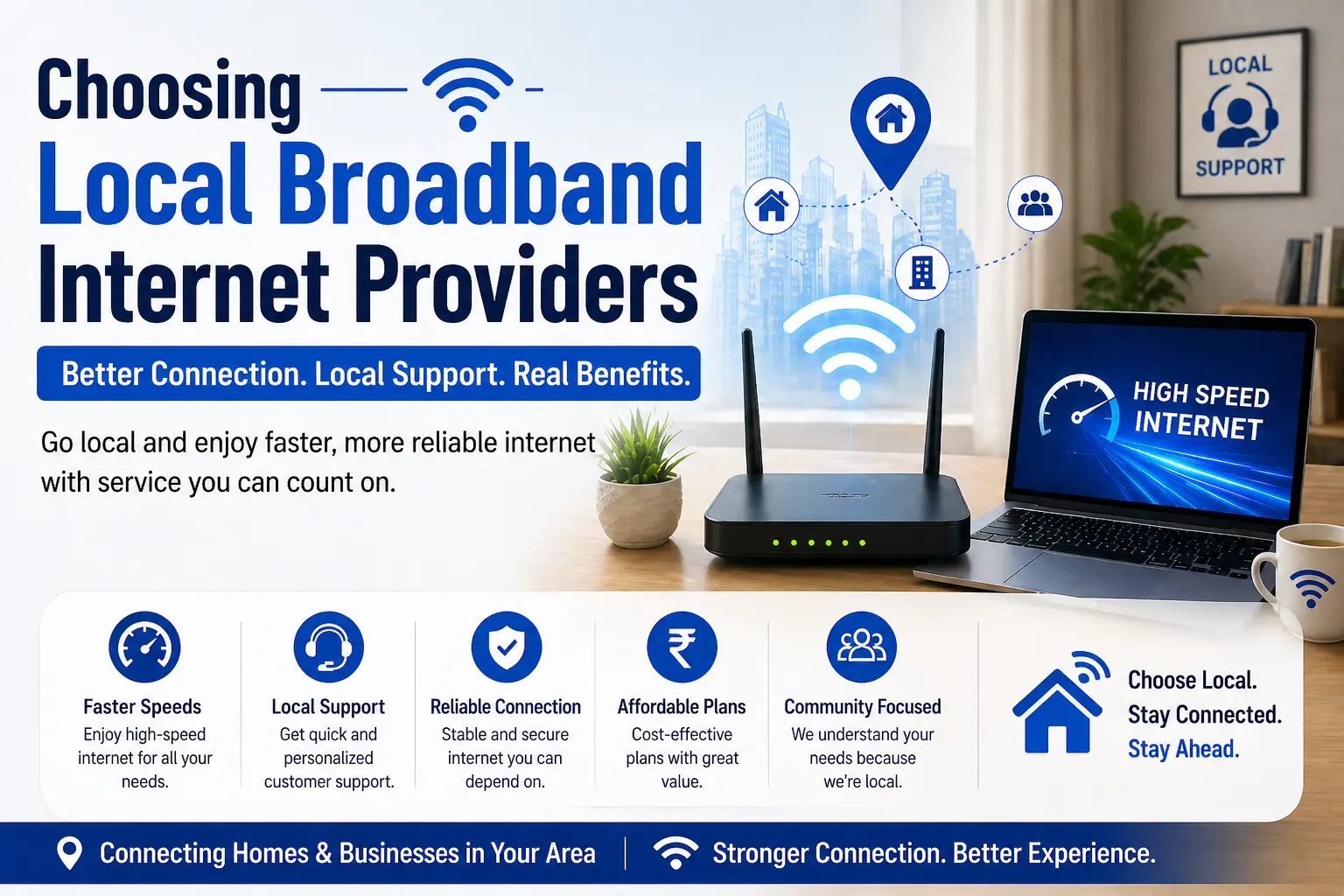
Faster, More Personal Support
Call a national ISP and you’re probably talking to someone in a call center three states away reading from a script. Call a local wireless internet provider and you’re often talking to someone who lives in your area, knows your neighborhood, and can send a technician out the same day.
That matters more than people admit. Downtime costs time and money, whether you’re running a home office or a small business.
- Local providers resolve issues faster on average
- Technicians are usually based nearby, not hours away
- Account managers often know customers by name
- Escalation paths are shorter and more direct
Better Pricing for What You Actually Get
National carriers charge for infrastructure across millions of miles. Local broadband internet providers don’t carry that overhead, which often means better value per dollar.
| Feature | National ISP | Local Broadband Provider |
| Average Contract Length | 12-24 months | Month-to-month often available |
| Hidden Fees | Common (equipment, admin) | Less frequent |
| Price After Promo Period | Often rises sharply | More stable long-term |
| Bundled Services You Don’t Need | Yes | Rarely |
We’re not saying local is always cheaper on the sticker. But the total cost of ownership, including equipment fees, support costs, and time lost dealing with problems, often favors local providers.
They Actually Know Your Area
A national ISP’s coverage map is built for marketing, not accuracy. Local wireless internet providers build their networks specifically for your geography. They know which neighborhoods have line-of-sight issues, which roads have infrastructure gaps, and what kind of weather affects signal quality in your area.
That local knowledge shows up in:
- More accurate service coverage before you sign up
- Faster identification of outage causes
- Infrastructure built for local conditions, not a national average
- Proactive communication during weather or maintenance events
You’re Supporting the Local Economy
Every dollar we spend with a local provider stays closer to home. Staff salaries, local taxes, vendor relationships, and community sponsorships all cycle back through the area economy rather than flowing to a corporate headquarters elsewhere.
According to various small business research studies, locally owned businesses recirculate a significantly higher percentage of revenue within their communities compared to national chains. The same principle applies to local internet service.
This isn’t just feel-good reasoning. It’s a practical consideration for communities that want to keep economic activity local.
Flexible Plans Without the Bureaucracy
We’ve all been through the experience of trying to change a plan with a national carrier. Forty-five minutes on hold, three transfers, and a retention specialist offering a deal that still isn’t what we asked for.
Local providers cut through that. Plan changes, upgrades, and cancellations are usually handled quickly and without drama. For businesses that need to scale bandwidth up or down based on seasonal demand, this kind of flexibility has real value.
More Reliable for Rural and Underserved Areas
National ISPs concentrate investment where the customer density justifies the cost. Rural areas get left behind. Local wireless internet providers fill that gap. They build networks in places that big carriers ignore, often using fixed wireless or other technologies that work well where cable and fiber aren’t available.
If we’re in a rural or semi-rural area, a local provider is often the only realistic option for getting a reliable connection. And many of them do it well.
Consistent Speeds, Not Just Advertised Speeds
“Up to” speeds are the fine print that haunt every national ISP advertisement. Local broadband internet providers, because they serve smaller geographic areas, often deliver speeds that are closer to what they advertise. Less network congestion, fewer shared segments, and more direct routes from the provider to our home or office.
Conclusion
Choosing a local broadband internet provider isn’t just about internet speed. It’s about support that actually responds, pricing that doesn’t hide the real costs, and a provider that understands your area because they live and work there too.
For our internet needs, especially if we’ve had frustrating experiences with national carriers, it’s worth giving local a serious look. R2 Net is one such local provider that brings reliable broadband and genuine local service to the communities it serves.
FAQs
Are local broadband internet providers as reliable as national ones?
Yes. Many local providers maintain strong uptime records and respond to outages faster because their teams are nearby. For rural areas, local providers are often more reliable than national options.
Do local wireless internet providers offer competitive speeds?
Most do. Fixed wireless and fiber options from local providers can match or exceed national ISP speeds in their service areas, with less congestion on shared network segments.
Are contracts required with local broadband internet providers?
Not always, and honestly this is one of the bigger perks. Many local providers don’t lock us into 12 or 24-month deals the way national carriers do. Month-to-month plans are common, which means we’re staying because the service is good, not because we’re stuck.
What if I need tech support after hours?
Check this before signing up. Some local providers have on-call teams for outages, others don’t. A quick question during the sales call tells us a lot about how they operate. If they hesitate or can’t give a straight answer, that’s worth noting.
How do I find local broadband internet providers in my area?
Skip the national comparison sites. They’re usually built around affiliate deals with big carriers. Instead, ask neighbors, check local Facebook groups, or look at community boards. People who already have the service will give us a more honest picture than any review site.